
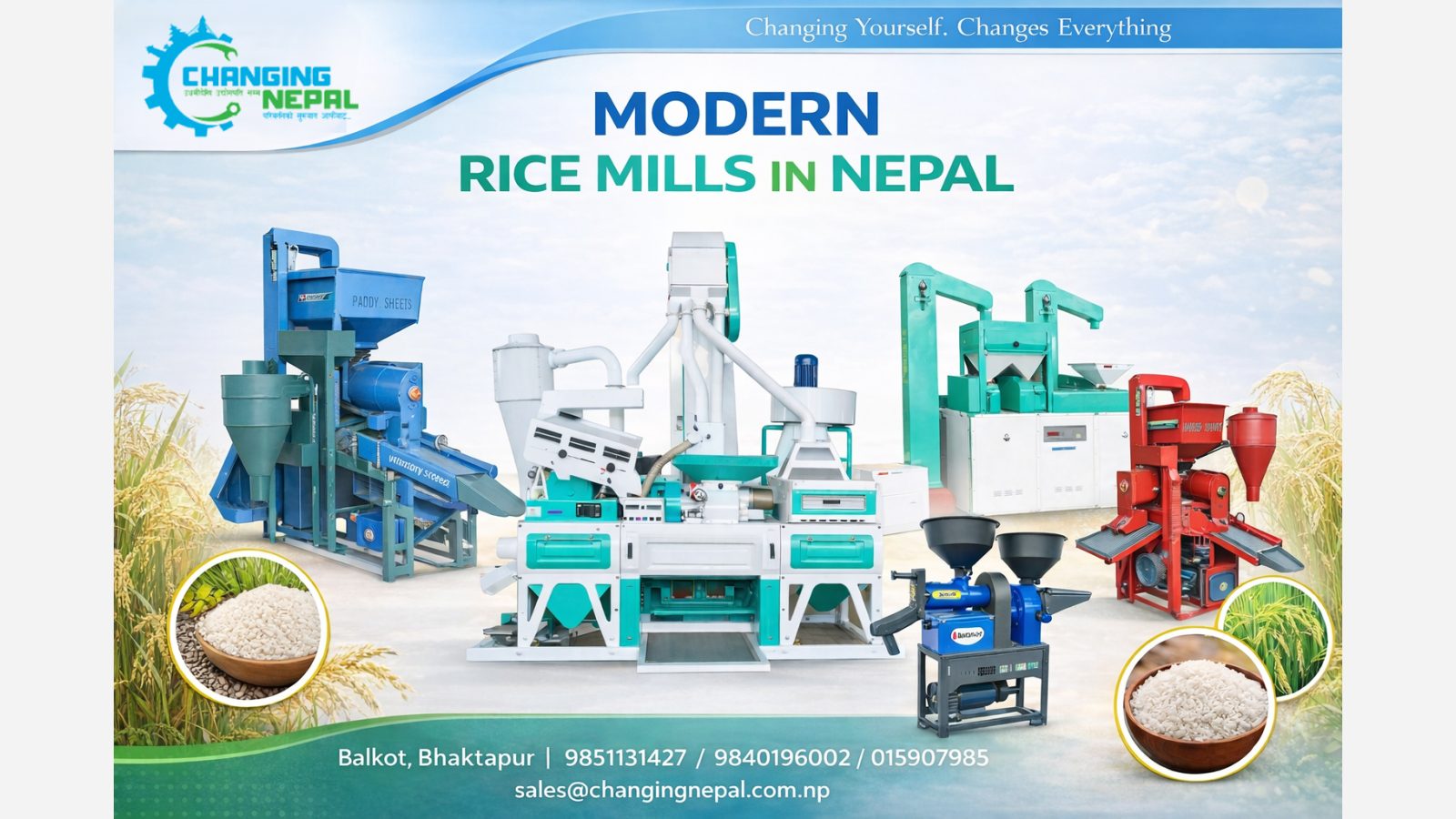
Rice is the most important food as well as agricultural production for the people of Nepal. Rice, cooked or raw, and even paddy has deep roots in various Nepalese cultures. Besides consumption, it is used for offerings, alcohol production and even as makeshift glue in Nepal.
Paddy is grown across Nepal, with the Terai region producing around 73% and low hills around 24% of the total production. Rice occupies largest share of farming land, contributes 7% to the country's GDP and 20% to the Agricultural GDP, thus is the backbone of economy. But, due to insufficient supply, Nepal spends over $200 million every year to import rice from other countries, mainly India.
Every year, an average person in Nepal eats about 137.5 kilograms of rice, which provides more than half of the total grains and a large portion of the protein supply. A 100g serving of white rice has around 80.3g carbohydrate, 7.04g protein and 1.03g fat. Brown rice contains slightly greater dietary fiber than white rice.
As the income and living standards of people improves, the demand for better-quality rice varieties like fine, aromatic and long-grain is high. However, much of locally grown rice is still processed using old machinery and techniques that have low efficiency. This often leads to broken grains and lower quality. Upgrading to modern rice mills (dhaan kutne mill or dhikki) can be a key step toward helping Nepal become self-sufficient. This also presents a great rice processing business opportunity with reasonable investment.
This article explores the rice milling process, types of rice processing machines available in Nepal, their price and specifications.
Section Links
- Rice Milling Process
- Rice Mills Available in Nepal
- Comparison Table
- Frequently Asked Questions (FAQs)
Rice Milling Process
Rice Milling is the process of processing harvested paddy (dhaan) into edible rice. It involves removing the outer husk and bran layers. The complete process is described as follows:
- Paddy Pre-Processing:
Paddy can contain impurities such as pebbles, soil and straw. These impurities can affect rice quality and damage milling equipment. Thus, in the pre-processing step, paddy is cleaned and such impurities are removed. In large industries, paddy pre-cleaner is usually 1.5 times the milling capacity. - Husking (Dehusking or Hulling)
Brown rice is produced by removing husk from rough paddy. Husk is removed by passing paddy between two abrasive surfaces moving at different speeds. - Paddy separation
After husking, a machine separates husk and brown rice. It also separates unhusked paddy. The brown rice obtained can also be consumed but, usually goes through polishing and turns into white rice. - Polishing (Whitening)
White rice is produced by removing bran and germ layers from brown rice. Brown rice passes through a rice polisher, where friction or pressure gently removes the outer bran layer from the grain surface. As the bran layer is removed, the rice becomes smoother, whiter, and more visually appealing. - Grading (Sorting)
In this step, rice grains are separated according to their size and quality. Small, broken or darker colored grains are differentiated from high-quality grains and stored or packaged accordingly. - Blending
This process involves mixing rice grains of different grades to maintain consistent quality and appearance. Although blending is optional, it is often used to reduce production cost. - Packaging
In this final step, the processed rice is packed into bags for storage, transport, and sale. Proper packaging protects the rice from moisture and contamination while making handling and distribution easier.
Rice Mill Machines Available in Nepal
1. Compact Rice Husker & Polisher

This is a two-in-one rice husker and polisher machine designed for small-scale rice processing. It is commonly used in small rice mills because it is easier to operate and requires lower investment.
| Specification | Details |
|---|---|
| Model | 6LN-5.4 |
| Capacity | 150 kg/hr |
| Power | 220V / 2.2 kW |
| Weight | 150 kg |
| Price (Nepal) | NPR 79,000 |
2. Husker (Huller) Machine
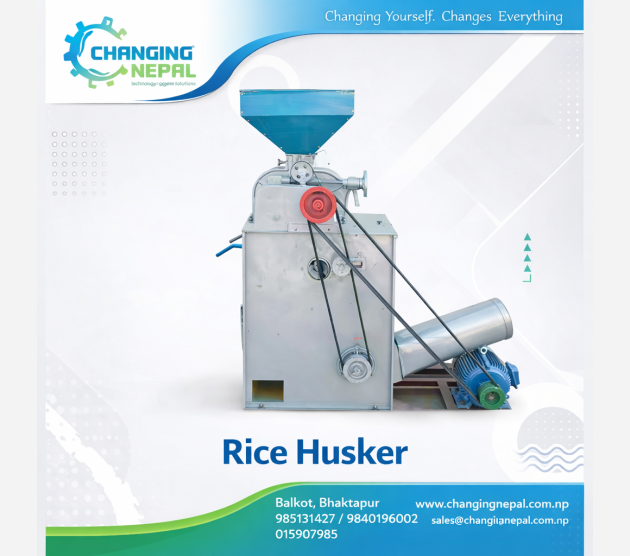
Rice husker is used to remove husk from paddy. This turns paddy grains into brown rice (rato chamal). All the paddy may not be husked properly in one pass thus two or more passes may be required. It is commonly used in small to medium rice mills. It is suitable for operators who want a dedicated husking unit and already have or plan to add a separate motor.
| Specification | Details |
|---|---|
| Capacity | Up to 500 kg/hr |
| Machine Price | NPR 99,000 (without motor) |
| Motor Required | 5 HP |
| Estimated Motor Cost | NPR 30,000 – 35,000 |
3. Rice Polisher Machine
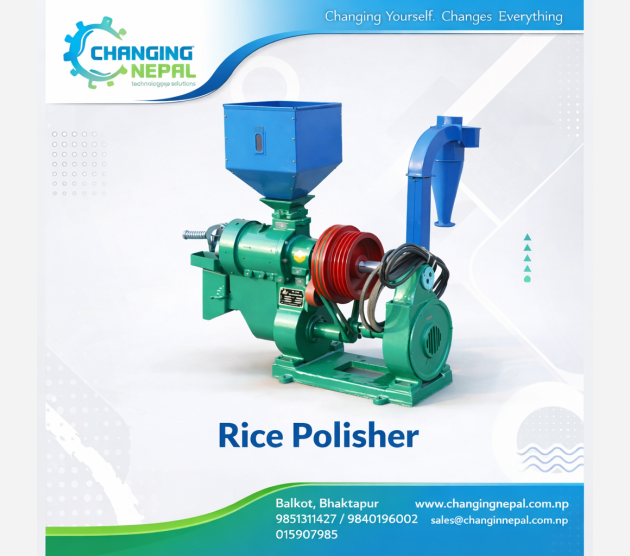
A rice polisher converts brown rice into white rice by removing the bran layer from the grain surface. This process improves the appearance, texture, and market value of rice. Rice polishers also produce rice bran, which can be used for oil extraction or animal feed.
| Specification | Details |
|---|---|
| Model | 110 |
| Capacity | Above 1000 kg/hr |
| Machine Price | NPR 99,000 (without motor) |
| Motor Required | 15 HP |
| Estimated Motor Cost | Around NPR 65,000 – 70,000 |
4. Rice Husker & Polisher (Medium to Large Scale)
This series includes combined rice husker and polisher machines in four different models: SB5, SB10D, SB30, and SB50. They are medium to large scale machines with combined husking and polishing capabilities.
| Specification | SB5 | SB10D | SB30 | SB50 |
|---|---|---|---|---|
| Output | 400–600 kg/hr | 800–1200 kg/hr | 1000–1500 kg/hr | 1700–2300 kg/hr |
| Power | 5.5 kW / 7 HP | 11 kW / 15 HP | 15 kW / 20 HP | 22 kW / 30 HP |
| Weight | 130 kg | 230 kg | 300 kg | 560 kg |
| Machine Size | 86 × 70 × 129 cm | 76 × 73 × 174 cm | 107 × 76 × 176 cm | 240 × 108 × 208 cm |
| Price Without Motor | NPR 145,000 | NPR 190,000 | NPR 220,000 | NPR 370,000 |
| Price With Motor | NPR 185,000 | NPR 235,000 | NPR 275,000 | NPR 430,000 |
5. Rice Husker and Polisher with Elevator

This machine integrates a rice husker, polisher, and elevator system into a single unit. It is suitable for small to medium scale rice mills requiring automated compact system with destoner support.
- Integrated elevator lifts paddy directly into the milling hopper.
- Produces both white rice and brown rice with processing capacity up to about 500 kg/hour.
- Whole rice recovery can reach approximately ≥72% with broken rice ≤3%.
| Specification | Details |
|---|---|
| Model No. | BB-RHM2024 |
| Capacity | Rice hulling: 600 kg/hr Rice milling: 500 kg/hr |
| Power | Approx. 8.6 kW |
| Voltage | 220V |
| Price (Nepal) | NPR 5,50,000 (with destoner) |
6. Mini Combined Rice Mill
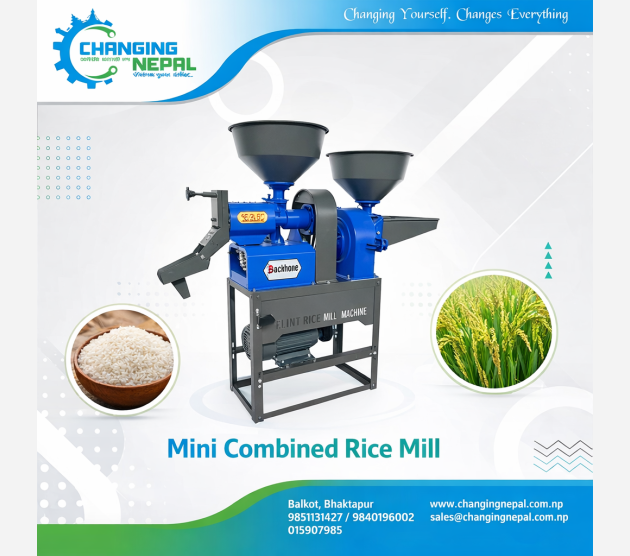
This is a basic combined rice mill that can process both paddy and grains.
- Dual-purpose machine for rice milling and flour grinding.
- Disc mill attachment allows grinding of wheat, maize, and similar grains.
- Compact design suitable for household or small village milling.
| Specification | Details |
|---|---|
| Rice Milling Capacity | 100 – 120 kg/hr |
| Flour Grinding Capacity | 130 – 150 kg/hr |
| Motor Power | 3 HP |
| Price (Nepal) | NPR 35,000 |
7. Combined Rice Mill (Butterfly Model)
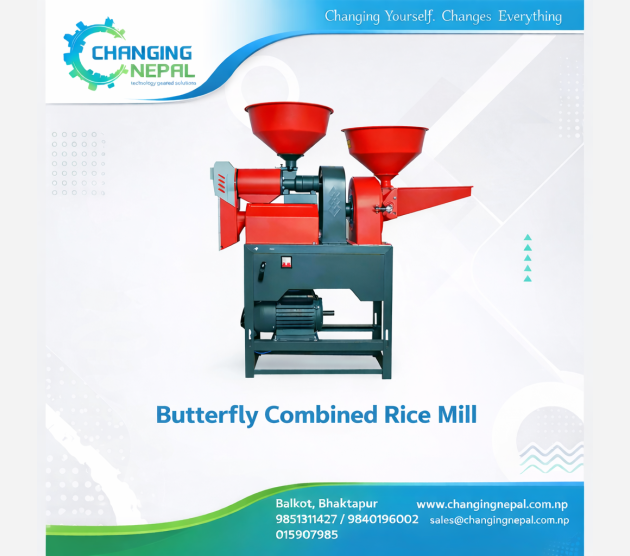
This butterfly-type combined rice mill also supports dual processing of paddy and grains.
- Dual-purpose system for rice milling and grain flour grinding.
- Safer enclosed milling chamber compared to traditional huller machines.
- Higher milling efficiency with reduced rice breakage.
| Specification | Details |
|---|---|
| Model | 6N20/40X-9FC21 |
| Rice Milling Capacity | 100 – 120 kg/hr |
| Flour Grinding Capacity | 130 – 150 kg/hr |
| Motor Power | 3 HP |
| Price (Nepal) | NPR 50,000 |
8. Mini Rice Mill

This is a small-capacity rice mill designed for household use and small farms that need simple paddy-to-rice processing.
- Compact machine suitable for home or village use.
- Simple paddy hulling and rice polishing in one unit.
| Specification | Details |
|---|---|
| Capacity | 150 kg/hr |
| Motor Power | 2.5 HP |
| Price (Nepal) | NPR 32,000 |
9. Mini Rice Pro Max
This upgraded mini rice mill includes impurity removal and rice grading features for cleaner rice output compared to basic mini mills.
- Integrated destoner removes stones and heavy impurities.
- Kanika separator separates broken rice from whole rice.
- Available in normal and cyclone models.
| Specification | Details |
|---|---|
| Motor Options | 3 HP / 4 HP |
| Normal Model Price | NPR 54,000 |
| Cyclone Model Price | NPR 55,000 – 57,000 |
10. N70 Rice Mill
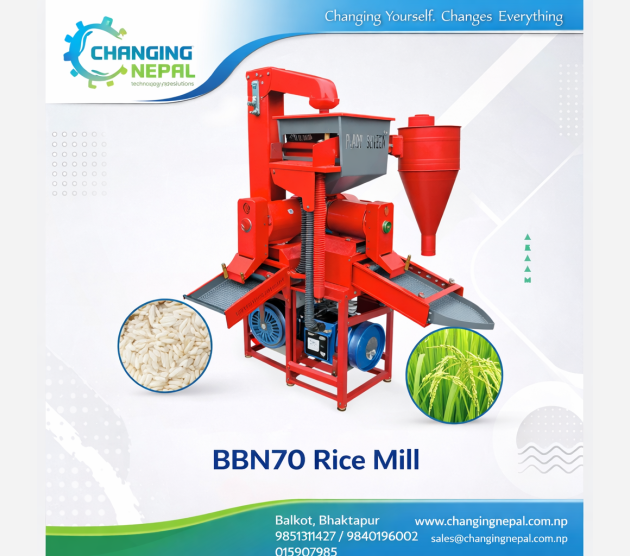
The N70 rice mill is a medium-capacity machine suitable for small commercial rice milling operations.
- Higher output than mini rice mills.
- Suitable for small rice milling businesses.
| Specification | Details |
|---|---|
| Model | BB-N70X |
| Capacity | 450 – 600 kg/hr |
| Motor Power | 11 HP |
| Price (Nepal) | NPR 1,25,000 |
11. 6N70 Pro Rice Mill
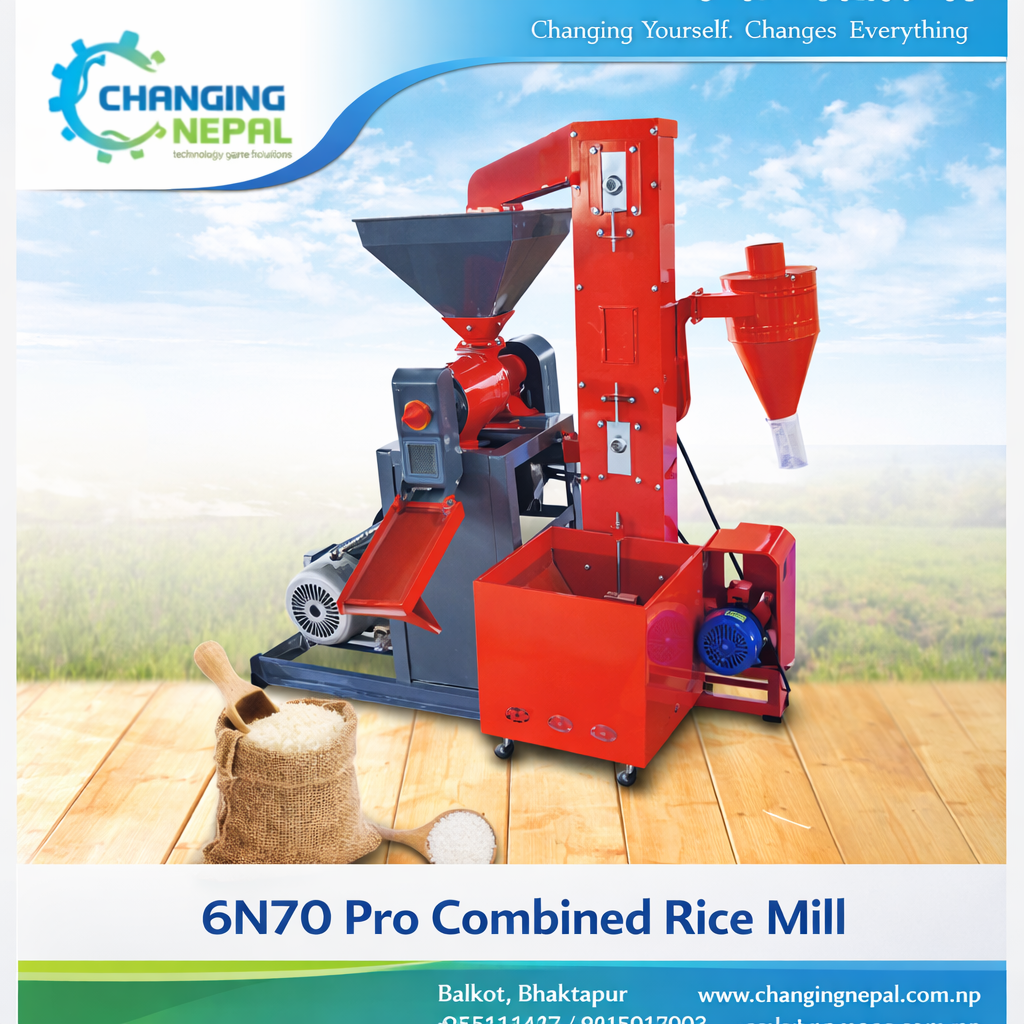
The 6N70 Pro is an upgraded version of the N70 rice mill designed for higher efficiency and commercial use.
- Improved milling efficiency compared to standard N70.
- Designed for continuous small commercial rice milling.
| Specification | Details |
|---|---|
| Capacity | 450 – 600 kg/hr |
| Motor Power | 11 HP |
| Price (Nepal) | NPR 1,80,000 |
12. N70PM / 6N70PM with Elevator Rice Mill
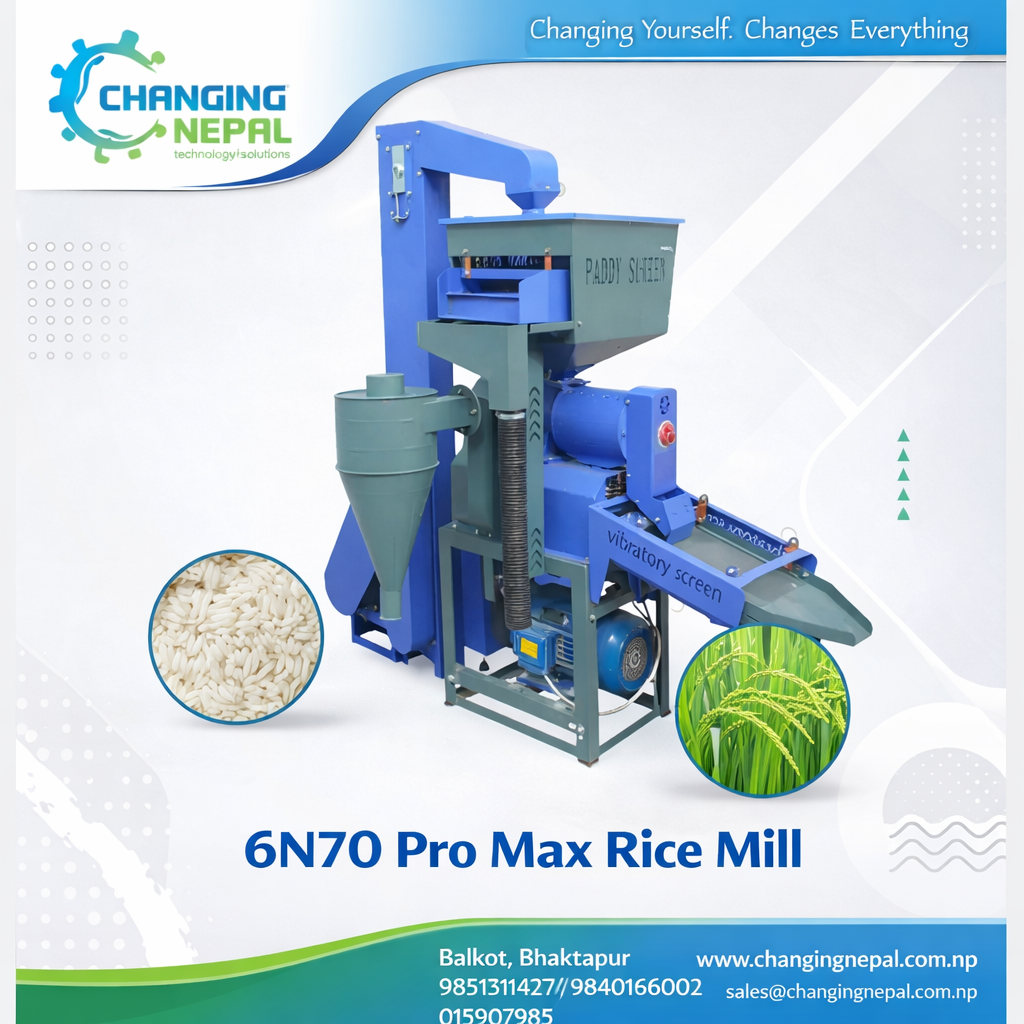
This model adds an elevator to the rice mill setup, helping automate feeding and improving the machine’s working efficiency. It is suitable for users who want a more complete medium-capacity rice milling solution.
- Integrated elevator automatically feeds paddy into the milling chamber.
- Includes impurity separator and broken rice separator for cleaner output.
- Reduces manual feeding and improves continuous milling operation.
| Specification | Details |
|---|---|
| Model | BB-N70 PM + Elevator |
| Capacity | 450 – 600 kg/hr |
| Power | 7.5 kW / 11 HP |
| Voltage | 380V |
| Price (Nepal) | NPR 2,20,000 |
13. N70-PM with Bhus Grinder
This machine combines rice milling with a bhus grinder setup, making it suitable for buyers who want rice processing and husk-related grinding in one system.
- Integrated bhus grinder allows utilization of rice husk by-product.
- Elevator-assisted feeding improves milling workflow.
- Dual-motor setup supports both rice milling and husk grinding.
| Specification | Details |
|---|---|
| Model | BB-N70 PM + Elevator |
| Capacity | 450 – 600 kg/hr |
| Power | 7.5 kW / 11 HP |
| Voltage | 380V |
| Price (Nepal) | NPR 2,90,000 |
| Additional Motor Note | 10 HP motor for rice mill and 3–4 HP motor for bhus grinder (220V) |
14. 6N-2000 PRO MAX Rice Mill
The 6N-2000 PRO MAX is a next-generation milling solution designed for higher efficiency, longer service life, and improved rice quality. It is suitable for users who need a heavy-duty rice mill with larger commercial output.
- Advanced grain separator design for smoother discharge and cleaner rice output.
- Tungsten carbide milling blades improve durability and service life.
- Energy-efficient system that reduces power consumption per ton of rice processed.
| Specification | Details |
|---|---|
| Product Name | Combined Rice Mill – 6N2000 PRO MAX |
| Production Capacity | ≥1000 kg/hr |
| Power | 20 HP (electric motor) |
| Machine Size (L × W × H) | 2065 × 1775 × 2510 mm (without elevator) |
| Price (Nepal) | NPR 3,50,000 |
15. Commercial Combined Rice Mill Plant

This is a complete rice milling production line designed for commercial rice processing. The system integrates machines for paddy cleaning, husking, whitening, grading, and conveying to produce high-quality white rice with minimal grain breakage.
- Includes paddy cleaner, destoner, rubber roller husker, paddy separator, rice mill, grader, elevators, and control system.
- Designed for continuous commercial milling with automated grain flow between machines.
- Optional grader size can be selected depending on required sorting capacity.
| Specification | Standard Model | High Capacity Model |
|---|---|---|
| Production Capacity | 600 – 1000 kg/hr | 1200 – 1500 kg/hr |
| Grader Type | Mini Grader | 3 ton/hr Big Grader |
| Price Range (Nepal) | NPR 9.8 – 11.5 lakh | NPR 14 – 15 lakh |
Comparison Table
| Machine | Capacity | Price | Purpose |
|---|---|---|---|
| Rice Husker & Polisher | 150 kg/hr | NPR 79,000 | Small-scale rice processing |
| Rice Husker Machine | Up to 500 kg/hr | NPR 99,000 + motor | Dedicated husking |
| Rice Polisher Machine | Above 1000 kg/hr | NPR 99,000 + motor | Dedicated polishing |
| SB Series Combined | 400–2300 kg/hr | NPR 145,000–430,000 | Small to medium mills |
| Husker & Polisher with Elevator | 500–600 kg/hr | NPR 5,50,000 | Automated compact milling |
| Combined Rice Mill | 100–120 kg/hr | NPR 35,000 | Rice + flour grinding |
| Butterfly Combined Rice Mill | 100–120 kg/hr | NPR 50,000 | Safer dual-purpose use |
| Mini Rice Mill | 150 kg/hr | NPR 32,000 | Home and farm use |
| Mini Rice Pro Max | 200 kg/hr | NPR 54,000–57,000 | Cleaner mini milling |
| N70 Rice Mill | 450–600 kg/hr | NPR 1,25,000 | Small commercial mills |
| 6N70 Pro Rice Mill | 450–600 kg/hr | NPR 1,80,000 | Higher-efficiency milling |
| N70PM with Elevator | 450–600 kg/hr | NPR 2,20,000 | Elevator-assisted milling |
| N70-PM with Bhus Grinder | 450–600 kg/hr | NPR 2,90,000 | Rice + bhus grinding |
| 6N-2000 PRO MAX | ≥1000 kg/hr | NPR 3,50,000 | Heavy-duty commercial use |
| Commercial Combined Rice Mill Plant | 600–1500 kg/hr | NPR 9.8–15 lakh | Commercial rice plants |
Frequently Asked Questions (FAQs)
1. Which machines are suitable for small-scale rice mill?
The machines like combined rice mill, butterfly rice mill, mini rice mill, mini rice pro max and compact rice husker & polisher are suitable for rice processing in small scale. They have small to moderate capacity of 100-200 kg/hr making them ideal for household, small farms and village-level rice milling.
2. Which machines are suitable for medium-scale rice mill?
The machines like Rice Husker & Polisher, N70 Rice Mill and 6N70 Pro Rice Mill are suitable for rice processing in medium scale. They have moderate capacity of 400-600 kg/hr, better rice recovery and stable operation as compared smaller rice mills. Thus, they are suitable for medium scale rice milling business.
3. Which machines are suitable for large-scale rice mill?
The machines like Rice Husker & Polisher (Large Scale), Rice Husker and Polisher with Elevator, 6N-2000 PRO MAX Rice Mill and Commercial Combined Rice Mill Plant are suitable for rice processing in large scale. These machines include cleaners, destoners, huskers, paddy separators, polishers, graders and elevators for complete processing of paddy into white rice. They have large capacity of 600 to over 1500 kg/hr and are designed for continuous industrial rice processing.
4. Which rice mill machine can process 1 ton of rice per hour?
To process 1 ton or greater amount of rice i.e. paddy in an hour, large scale machines like Rice Husker & Polisher (Large Scale), 6N-2000 PRO MAX Rice Mill and Commercial Combined Rice Mill Plant are suitable. They are high-capacity machines that are capable of continuous processing.
5. What is the price of rice mill machines in Nepal?
The price of rice mills in Nepal varies depending upon the features and processing capacity. The typical price is:
- Mini rice mills: around NPR 30,000 – 60,000
- Medium rice mills: around NPR 1 lakh – 3 lakh
- Commercial rice mill plants: around NPR 9 lakh – 15 lakh or more.
6. How do I choose the right rice mill capacity for my needs?
The right rice mill capacity depends on daily paddy processing volume, electricity availability, and budget. Small farms usually need 100–200 kg/hr machines, small businesses use 400–600 kg/hr machines, while commercial mills require 1000 kg/hr or higher capacity rice milling systems.
7. Why does rice husking and polishing sometimes require multiple passes?
Depending upon the quantity of paddy processed in one pass and the nature of husker or polisher, two or more passes may be required. The abrasive surface of the husker or polisher may not be in contact with all the paddy grains and some may be left out thus two or more passes may be required.
8. What is brown rice (Rato Chamal) and how is it produced?
Brown rice, commonly called Rato Chamal in Nepal, is rice where the outer husk is removed but the bran layer remains intact. It is produced after the husking stage but before polishing. Brown rice contains more fiber, vitamins, and nutrients than fully polished white rice.
9. What factors affect the rice recovery rate during milling?
Rice recovery depends on several factors including paddy moisture content, machine quality, milling settings, and grain variety. Properly dried paddy and well-maintained rice mill machines can significantly improve whole rice recovery and reduce broken grains.
10. What is the difference between a rice husker and a rice polisher?
Rice husker produces brown rice by removing the rough outer covering (husk) from paddy grains. Rice polisher produces white rice by removing bran and germ layers from brown rice. The output of rice husker is the input of rice polisher.
11. What machines are included in a commercial rice mill plant?
A commercial rice mill plant typically includes paddy cleaner, destoner, rubber roller husker, paddy separator, rice polisher, rice grader, elevators, and a control system. These machines work together to process paddy into high-quality white rice efficiently.